
Floating Dock vs Fixed Dock: Which Dock System Is Better for Your Waterfront Property
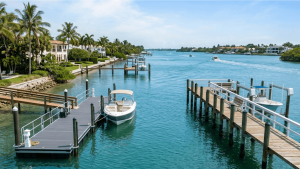
Are you planning to build a dock system for your waterfront property? Well, then you must’ve done your research, and chances are you’ve come across two primary types: floating docks and fixed docks, but which one to choose?
Well, the thing is, choosing between a floating dock and a fixed dock isn’t just a matter of appearance or price. The better option depends on your shoreline, water depth, water-level changes, boat access, maintenance expectations, and how the dock will be used.
But don’t worry, we’ll tell you exactly which one’s the right choice for you. At Marine Construction, we know a thing or two about residential dock systems (we’ve been in Palm Beach and Martin County since 1985).
Quick Answer
- Floating docks are generally better where water levels fluctuate, accessibility at different water levels matters, or a flexible dock layout is preferred.
- Fixed docks can be better where a permanent, highly stable platform is more appropriate for the shoreline and water conditions.
Looking for trusted and reliable services in Palm Beach & Surrounding Areas?
Check Marine Construction Dock Services.
What Is a Floating Dock and How Does It Work?
Simply put, a floating dock is a dock structure supported by flotation (buoyant floats or pontoons) rather than by fixed supports and/or being fixed at a permanent elevation above the bottom.
As water levels rise or fall, the floating platform rises and falls with them. Depending on the design and site conditions, the dock may be connected to the shore and restrained using pilings, guide posts, cables, anchors, or other systems that limit horizontal movement while allowing vertical movement.
Floating docks may be used for:
- Boat access
- Swimming
- Fishing
- Kayaks
- Paddleboards
- Personal watercraft
and other waterfront activities.
For a residential waterfront, the biggest advantage is adaptability.
Benefits Of Floating Docks
Here are some of the core benefits of this dock system:
- Better access during changing water levels: Because the platform moves with the water, the distance between the dock and water surface remains relatively consistent.
- Flexible design: Floating dock systems can often be configured around the needs of the property, boat access, and available waterfront space.
- Potentially simpler adaptation: A floating system can be useful where installing a conventional fixed structure at a single elevation is less practical.
- Versatility: Floating docks can support a wide range of recreational uses, although their allowable loads and configuration must be designed for the intended application.
Important Note
Florida law specifically recognizes floating docks as one type of dock construction that may qualify for certain exemptions when the applicable requirements are met. Those requirements include limits relating to dock size, use, navigation, and environmental impacts.
To learn more, please refer to the official guidelines at the Florida Department of Environmental Protection and the Florida Senate.
What Are the Disadvantages of Floating Docks?
Despite the upside, there are certain downsides to this dock system, including:
- Movement: The dock moves with the water. That is an advantage for fluctuating water levels, but it may feel less rigid than a fixed dock.
- Anchoring requirements: A floating dock needs an appropriate restraint system to control horizontal movement while allowing the dock to rise and fall.
- Wave and storm exposure: A floating structure must be engineered for its particular site. Waterfront properties exposed to stronger waves, wakes, currents or tropical storms require careful design.
- Connection points: Hinges, gangways, guide systems, anchors, connections and other hardware need regular inspection.
- Environmental limitations: Dock placement and design may need to account for aquatic vegetation, submerged resources and navigation.
What Is a Fixed Dock and How Does It Work?
A fixed dock, sometimes called a stationary dock, is supported by permanent structural elements such as pilings.
Unlike floating docks, a fixed dock remains at a predetermined elevation, which means it does not rise and fall with the water.
This makes fixed construction attractive when the waterfront conditions are relatively stable, and the property owner wants a rigid walking and working surface.
Benefits Of Fixed Docks
Compared to floating dock systems, this one doesn’t offer varying advantages. Still, you get the following benefits:
- Greater rigidity: A properly engineered fixed dock provides a stationary platform that does not move vertically with normal water-level changes.
- Permanent structure: Fixed docks can provide a traditional waterfront appearance and a defined layout.
- Suitable for certain waterfront conditions: Where water depth, shoreline configuration, and environmental conditions make piling-supported construction appropriate, a fixed system may be the better fit.
What Are the Disadvantages of Fixed Docks?
Despite their stability, fixed docks also have certain downsides, including:
- Fixed elevation: The dock remains at a set height above the water. Significant changes in water level can make boarding more difficult or cause the dock to sit too high or become partially submerged.
- More complex installation: Fixed docks typically require pilings driven into the bottom, which can make installation more labor-intensive and dependent on water depth and bottom conditions.
- Higher installation costs: Pile installation, equipment, and site-specific engineering can increase the upfront cost compared with some floating dock systems.
- Limited flexibility: Because the structure is permanently supported by pilings, changing its layout, relocating it or expanding it can be more difficult than modifying a modular floating system.
- Permitting and environmental considerations: Fixed docks may require piling installation and must meet applicable requirements for navigation, water flow and impacts on submerged lands, aquatic vegetation and wildlife. Florida law specifically addresses these considerations for private.
So, Which of These Dock Systems is Better?
Well, the answer to this question depends on your property, environment, and of course, preference.
Choose a floating dock when:
- Water levels change significantly
- You want more consistent access to the water
- A flexible or modular layout is important
- The waterfront makes a permanent elevation less practical
- You need a dock that can adapt vertically to changing water conditions
Consider a fixed dock when:
- The water level is relatively stable
- A rigid walking surface is a priority
- The site is suitable for permanent piling-supported construction
- You prefer a traditional permanent dock configuration
- Your intended use benefits from a stationary structure
You should also know that there’s a third option that can also make sense: a hybrid or specialized dock that combines a fixed section near shore with a floating section farther out. This can provide a stable transition from the property while allowing the outer section to follow water-level changes.
What Should You Consider Before Choosing a Dock?
Here are some of the considerations to keep in mind when choosing a dock system:
1. How much does the water level change?
Helps determine whether a floating system is advantageous.
2. How deep is the water?
Influences dock design, access and support requirements.
3. Is the site exposed to waves or wakes?
Affects structural and anchoring requirements.
4. What will the dock be used for?
Determines size, layout and load requirements.
5. What boat will use the dock?
Influences access and configuration.
6. Are aquatic resources present?
Can affect placement, design, and permitting.
7. Is a boat lift required?
May affect dock layout and structural requirements.
8. How much maintenance is acceptable?
Helps determine material and system preferences.
9. What is the project budget?
Influences materials, size, accessories and installation.
10. What permits are required?
Determines project process and potential restrictions.
Not sure which dock system will be ideal for you? Contact our experts to decide on the ideal choice for your property. Schedule a Consultation
Pricing Comparison for Floating and Fixed Docks
This is where things get interesting. The thing is, the structure, materials, and other factors will dictate how much you will be paying for each dock. By analyzing multiple sources, the pricing range currently sits at:
- $15–$35 per square foot for a floating dock
- $30–$60 per square foot for a fixed piling dock
But if you consider the following in your calculations:
- Structural framing
- Decking
- Flotation components
- Shore connections
- Hinges or gangways
- Guide piles or anchoring systems
- Hardware and corrosion-resistant components
- Engineering and site preparation
- Permitting and environmental requirements
- Transportation and installation
- Boat lifts or other accessories
You are looking at the overall price range of:
- $3,000 to $15,000+ for a floating dock
- $15,000 to $30,000 for a fixed dock
While these may appear as a massive investment initially, it should be noted that building a dock system in Palm Beach and Martin County can significantly increase your property’s value.
To learn how, check our guide: The Role of Docks in Enhancing Waterfront Property Value.
Choosing the Right Dock for Your Property and Requirements
Well, the ultimate decision should be made with one understanding: how the dock needs to interact with the water.
- Choose a floating dock when adaptability to changing water levels, flexible access, and a configurable layout are priorities.
- Choose a fixed dock when a stationary platform, permanent structure and site conditions make piling-supported construction the more appropriate solution.
Frequently Asked Questions
What are the disadvantages of floating docks?
The main disadvantages are movement, anchoring requirements, exposure to waves and wakes, maintenance of connections and hardware, and potential environmental or permitting limitations. Their suitability depends heavily on site conditions.
Why are floating docks so expensive?
The cost includes more than the floating platform itself. Flotation, framing, decking, shore connections, anchoring, gangways, engineering, permitting, transportation, installation and accessories can all contribute to the final cost.
What is the average lifespan of a floating dock?
There is no universal average lifespan. The service life depends on materials, construction quality, water conditions, corrosion exposure, usage and maintenance.
How much weight can a floating dock support?
Weight capacity varies by the dock’s dimensions, flotation, framing, materials, load distribution and engineering. Always use the capacity specified for the particular dock system rather than relying on a generic online figure.
How do I anchor my floating dock to the shore?
Floating docks can use guide piles, hinged gangways, shore connections, anchors or other engineered restraint systems. The appropriate configuration depends on water depth, shoreline conditions, waves, wakes and expected water-level changes.
How expensive are floating docks?
There is no reliable single price for all floating docks. The final cost depends on dock size, materials, flotation, anchoring, site conditions, permitting, installation and accessories. A site-specific quote provides a more meaningful estimate than a generic price range.
Do floating docks require permits in Florida?
Some floating docks may qualify for statutory exemptions, but exemptions have specific conditions. Florida requirements can depend on dock size, waterbody designation, aquatic resources, navigation, construction and use. Always verify the requirements that apply to the specific property.